Guide
Gummy supplements explained: how they differ from capsules and tablets
A gummy supplement packs active ingredients into a chewable base, usually pectin or gelatin, with sweeteners and flavor. It is easier to take than a capsule but holds less active ingredient, may contain sugar or sugar alcohols and needs careful storage. Read the Supplement Facts panel for amounts, and the other ingredients for what else you eat.
Written by the Burn Gummy label deskUpdated
The basics01
What is a gummy supplement?
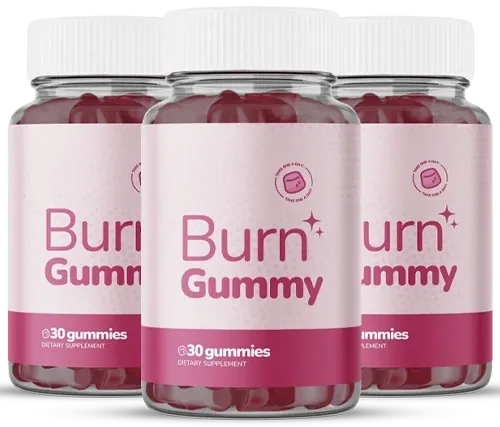
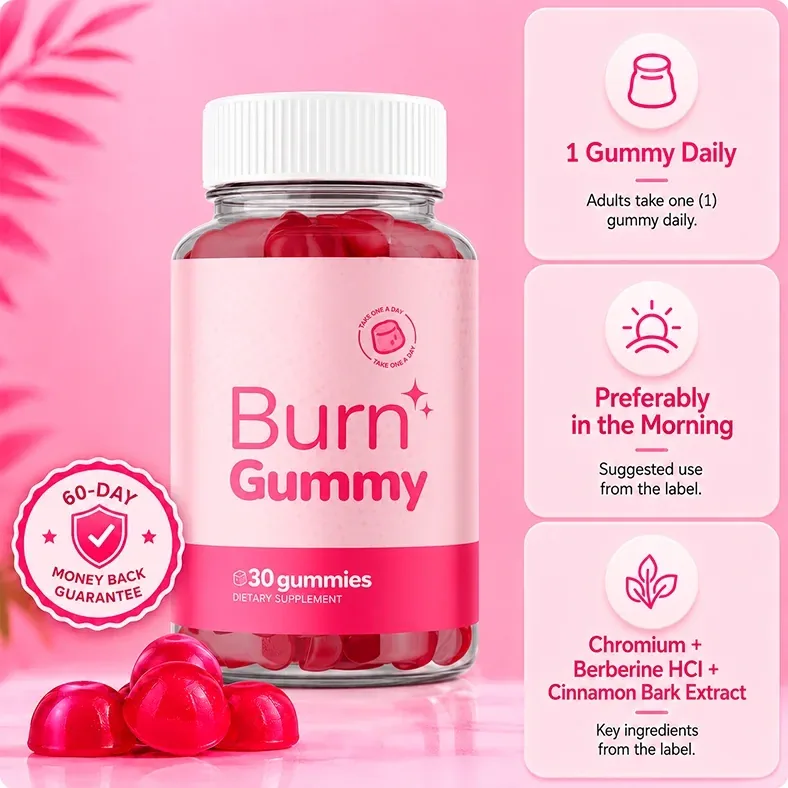
It is a chewable dosage form: a soft gel of pectin or gelatin that carries active ingredients along with sweeteners, flavor, color and an acid for taste. People like them because there is no pill to swallow and the flavor is pleasant, which helps with daily habits. Burn Gummy is one example, with pectin among its listed ingredients and one gummy per serving.
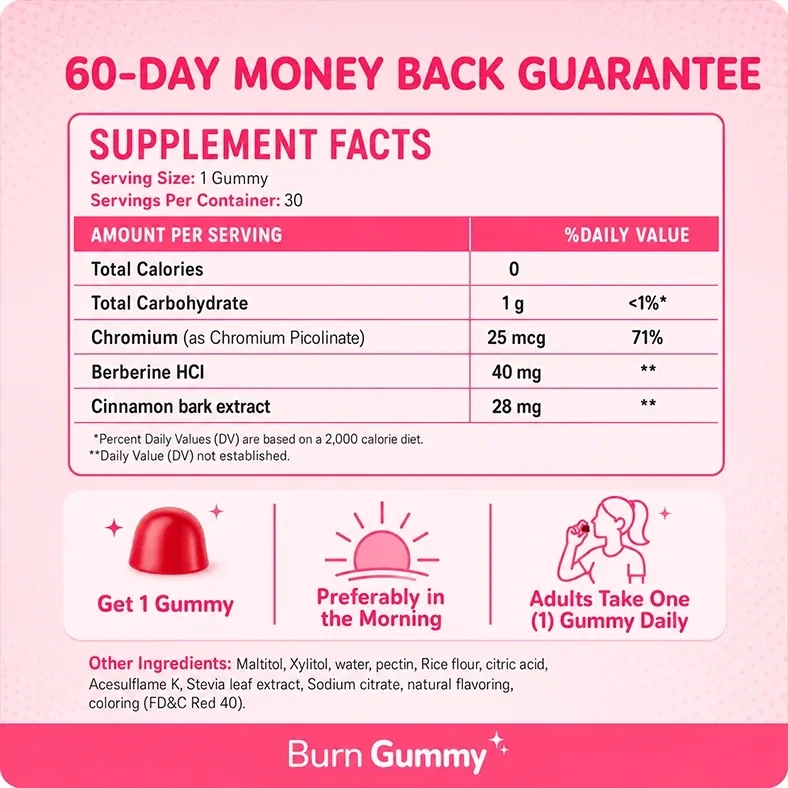
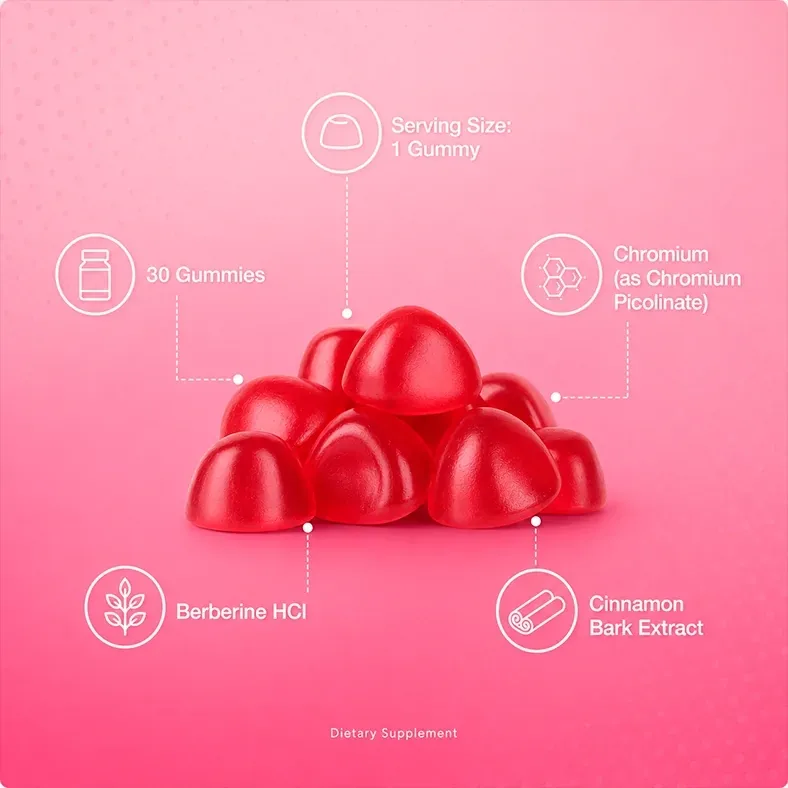
The label graphic gives the amounts per gummy: chromium 25 mcg, berberine hydrochloride 40 mg and cinnamon bark extract 28 mg. The supplement facts page explains each line.
Compare02
How do gummies compare with capsules and tablets?
| Feature | Gummy | Capsule | Tablet |
|---|---|---|---|
| Ease of taking | Easy, chewable | Needs swallowing | Needs swallowing |
| Room for active ingredient | Limited | Moderate | Moderate to high |
| Added sugar or sugar alcohol | Usually yes | Usually none | Little |
| Color, flavor, acid | Usually added | Minimal | Minimal |
| Sensitive to heat and humidity | Yes, can melt or stick | Less | Less |
The trade is convenience against capacity. A gummy suits an ingredient that works at small amounts. It struggles with ingredients that need hundreds of milligrams, which is partly why a product with berberine at 40 mg is far below the doses used in many trials. (Elahi Vahed et al., Int J Obes 2026)
Ingredients03
What else is in the gummy besides the active ingredients?
Burn Gummy lists eleven other ingredients: maltitol, xylitol, water, pectin, rice flour, citric acid, acesulfame K, stevia, sodium citrate, natural flavoring and FD&C Red 40. Pectin sets the gel, the sugar alcohols and sweeteners give taste without much sugar, citric acid and sodium citrate balance acidity and the dye gives color.
Each has a trade-off. Sugar alcohols can loosen stools when eaten in quantity. (Makinen, Int J Dent 2016) FD&C Red 40 is a color additive permitted by the FDA. (eCFR, 21 CFR 74.340 (Red 40)) A reader who avoids dyes or sweeteners should choose with that in mind. The sweeteners and other ingredients page goes through each in turn.
Dose04
Why are gummy doses often small?
A gummy is mostly gel and sweetener. Packing hundreds of milligrams of a bulky or bitter ingredient into it makes it too big, too bitter or too hard to set. Makers therefore use small amounts, or ingredients that are potent at small amounts, or split a dose over several gummies.
This is neither good nor bad by itself. It matters when marketing quotes studies done at doses much higher than the product supplies. The sales page for Burn Gummy refers to a clinical background; the trials we can find were of single ingredients at other amounts. (FTC, Health Products Compliance)
Reading a label05
How do you read a gummy supplement label?
Find the serving size
Some gummies call for two or three at a time. Burn Gummy lists one.
Check the amounts
Compare milligrams or micrograms with the research you read about. (21 CFR 101.36 (eCFR))
Read the other ingredients
Look for sweeteners, dyes and allergens.
Look for a lot code and date
It lets you check a batch and discard old product.
Storage06
How should you store gummies?
- Keep the jar closed, cool and dry. Heat makes gummies soften and stick together.
- Do not leave it in a hot car or in a sunny window.
- Store out of reach of children, who may mistake it for candy, and of dogs, since xylitol is dangerous to them. (FDA, Xylitol and dogs)
- Throw away gummies that change color, smell off or have grown hard.
Who benefits07
Who might prefer a gummy?
Adults who struggle with capsules, or who keep better habits with something pleasant, may do better with a gummy. The risk is the candy effect: it is easy to eat more than the label says. Take one a day as directed, and do not treat the gummy as a snack. If you manage blood sugar or watch sweeteners, read the label before you choose. See the who it is for page for a fit check.
Myths08
Which gummy supplement beliefs are worth correcting?
Three beliefs come up often. The first is that a gummy is a vitamin by definition: a gummy is only a dosage form, and the ingredient inside decides what it is for. The second is that a gummy is automatically gentler than a capsule: the sweeteners can upset the stomach in some people, and the active ingredients are the same chemicals. The third is that a natural flavor and a fruit color mean a natural product. Burn Gummy lists a synthetic dye, FD&C Red 40, and the sweetener acesulfame K among its other ingredients, so a blanket natural claim does not fit the label.
None of this makes gummies a poor choice. It means the choice should rest on what is in the jar and on your own needs, not on the format.
Quality09
Can the amount in a gummy differ from the label?
It can, as with any supplement, because the FDA does not test products before sale and the maker is responsible for the label. Gummies are harder to make precisely: ingredients can settle in the mix, heat can break some down and the gel can change over its shelf life. A reliable maker tests finished lots and keeps a certificate of analysis. Ask for it, as the batch verify page suggests, and be a little cautious with any gummy whose maker will not name a laboratory.
Sources10
Which sources back this guide?
- Gastrointestinal Disturbances Associated with the Consumption of Sugar Alcohols with Special Consideration of Xylitol. Kauko K. Makinen, International Journal of Dentistry, 2016.Sugar alcohols may cause gastrointestinal disturbances, at least in people not used to them. In the cited studies 35 g of maltitol a day did not affect well-being or stools, 40 g caused mild gas, and 45 g caused transient diarrhea in 29 of 34 subjects; FDA lists maltitol as GRAS with a laxative warning above 100 g a day for adults. Xylitol is better tolerated than sorbitol or mannitol.
- 21 CFR 74.340 - FD&C Red No. 40. Electronic Code of Federal Regulations, 2026.FD&C Red No. 40 may be safely used for coloring foods (including dietary supplements) in amounts consistent with good manufacturing practice, and every batch must be certified. This is a legal listing, not a claim that every person tolerates it.
- 21 CFR 101.36 - Nutrition labeling of dietary supplements. Electronic Code of Federal Regulations, 2026.Sets out what a Supplement Facts panel must list for dietary supplements, including the serving size, servings per container and the amount of each dietary ingredient.
FAQ11
Gummy supplements: questions
Are gummy vitamins as effective as pills?
They can be, if the amounts are right, but they often hold less active ingredient and add sweeteners.
Why do gummies contain sugar alcohols?
They give sweetness and bulk with less sugar. In larger amounts they can loosen stools.
Do gummies need refrigerating?
Usually not, but they must stay cool and dry. Follow the label.
Can I take more than one gummy a day?
Only as the label directs. More is not better and adds sweetener and active ingredients.
Is pectin vegetarian?
Pectin is a plant fiber from fruit, whereas gelatin comes from animals. Check the label for gelatin.
Why did my gummies stick together?
Heat or humidity softened them. Store the jar cool and dry, and ask the seller if they arrive melted.
Are gummies safe for children?
Not unless the label says so. Keep them out of reach, because they look like candy.
Who wrote this12
Written and reviewed by
Pages built from the label graphic, the sales page and linked NIH, FDA, CDC, FTC and peer-reviewed sources.
Last updated . Read our editorial standards and how we check reviews. This website is run by Myburngummy, a U.S. stocking partner for Burn Gummy, not by the manufacturer. We make money when you buy through our order links.
Keep reading
More about Burn Gummy
U.S. stocking partner for Burn Gummy
Ready to try Burn Gummy?
Check your medicines first, then pick a pack. Six jars cost the least per jar, and every pack carries the 60-day money-back guarantee on the sales page.
- Checkout on the sales page
- 60-day money-back guarantee
- Shipping shown at checkout